Sheppard Pratt Patient Journey Mapping
ROLE
Lead Architect
SCOPE
Research · UX
PLATFORM
Digital media campaign
AUDIENCE
Patients, Caregivers, Providers
Finding help shouldn't be the hardest part of getting it.

Sheppard Pratt offers some of the deepest clinical access in inpatient mental health care - psychologists, psychiatrists, specialized teams. None of it mattered if people couldn't get through the digital front door.
Potential patients and caregivers who were facing one of the hardest decisions of their lives ran into a long form and no way to know if the program was the right fit. People were leaving because it was a generic solution to a sensitive topic. At a time where users often had the most questions, the least amount of information was available.
And providers were spending important time answering common questions and screening unqualified leads.
This research work was to map these journeys and build a well-targeted, informed media campaign. Without access to real patients, insights had to lean on what already existed:
-
Staff leadership working sessions
-
Clinical teams fielding inquiries and triaging leads by hand
-
Caregiver-facing touchpoints across the research-to-inquiry-to-admission funnel

Lengthy, generic form put the burden on the caregiver
The user journey maps made the failure points hard to miss.
Mapping patient, caregiver, and provider paths side-by-side mattered. Each side experienced the process differently, an visually identifying gaps between those experiences was where the most friction and opportunity lived.

I mapped every touchpoint of existing patient workflows from research, to pre-admission, to admission, and treatment plan.
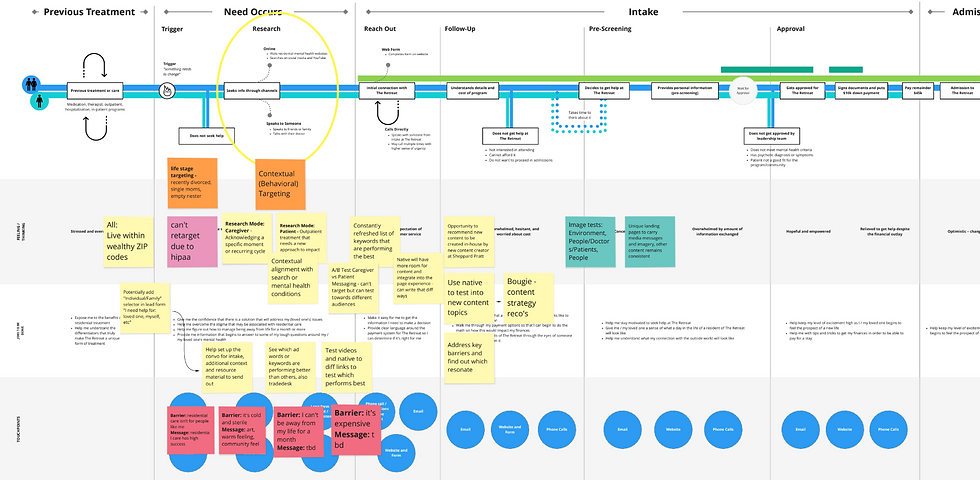
Then layered in provider workflows and research insights to build the end-to-end journey.

We identified barriers that stopped people from seeking help, and how campaign messaging could evolve around them.

And surfaced opportunities for A/B testing messaging and imagery across the media campaign.
Results
Small changes in
Journey insights went to the media team to build a targeted ad campaign answering caregiver most common questions and pre-qualifying them before they ever touched the form - and helping do the screening work that used to fall entirely on staff.
Less manual triage
Pre-qualified leads from the campaign could cut the hours staff spent screening submissions that were never going to convert.
Less form abandonment
A shorter, resumable intake can remove the moment where overwhelmed caregivers used to disappear.
Pricing surfaced earlier
Caregivers should enter the conversation informed, not blindsided by an unexpected price point.
Shared reference point
Journeys for patients, caregivers, and the providers gave a common foundation for the organization.